Police Clearance Requirements: Everything You Need Before You Book an Appointment
Have you ever spent half a day lining up for a government document, only to be told you’re missing a requirement?
It happens more often than people think.
As someone who has helped hundreds of job applicants prepare their pre-employment documents, I’ve seen the same problem again and again. A person takes time off work, travels to a police station, waits for their turn, and then discovers that their ID isn’t accepted, their online registration isn’t complete, or they brought the wrong documents. The result? Another trip. More waiting. More stress.
The good news is that most of these problems are completely avoidable.
If you’re applying for a job, processing government paperwork, starting a business, or simply completing a personal requirement, knowing the exact police clearance requirements before you begin will make the process much easier. A little preparation can save you hours.
Many applicants search online asking, “What are the requirements for police clearance?” Unfortunately, they often find outdated information or advice that doesn’t match the current National Police Clearance System. That’s why this guide was created.
Here, you’ll learn the latest requirements for police clearance, the accepted IDs, payment rules, appointment procedures, first-time jobseeker benefits, and common mistakes that delay applications. Whether you’re applying for a Philippines police clearance for the first time or renewing an existing record, this guide will help you avoid unnecessary headaches.
What You Need to Know
Before you start your application, keep these points in mind:
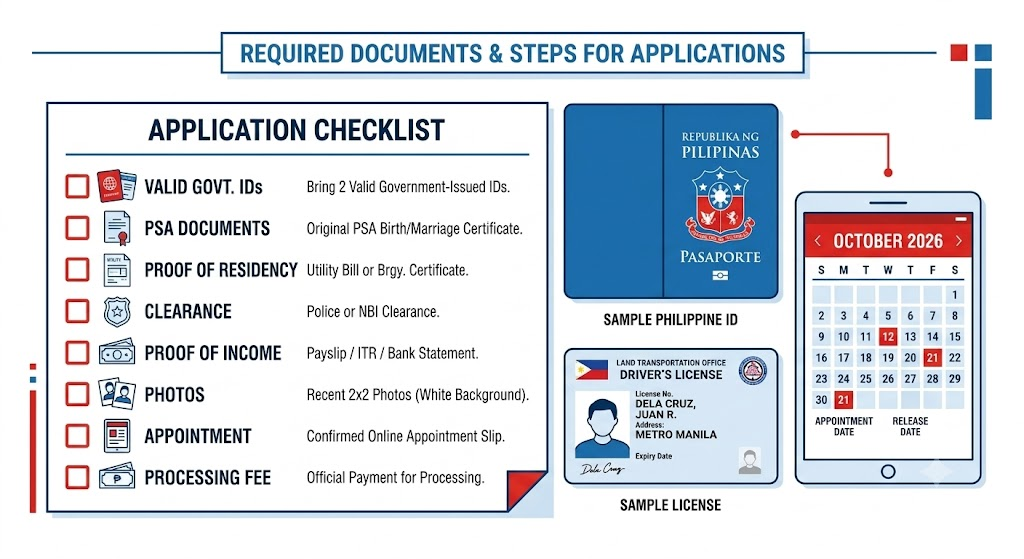
- Bring a valid government-issued ID that matches your registration details.
- Complete your online registration before visiting a police station.
- Book an appointment and choose your preferred processing location.
- Pay the required fee through an approved payment channel.
- Appear in person for biometric capture and identity verification.
- First-time jobseekers may qualify for a fee exemption if they meet the requirements.
- Incorrect personal information can trigger delays and additional verification.
- A database “Hit” does not automatically mean you have a criminal record.
By the end of this guide, you’ll know the exact requirements to get police clearance, what documents to prepare, how the process works from start to finish, and what you can do to avoid the mistakes that slow many applicants down.
Police Clearance ID Requirements: What NPCS Actually Accepts
The police clearance id requirements under the NPCS system are strict because your ID is the foundation of your identity match. If your ID fails verification, your application stops immediately.
Officers do not accept unclear, expired, or mismatched identification. The system is designed to reject weak identity proofs to avoid false records.
The Ultimate List of Accepted Valid IDs
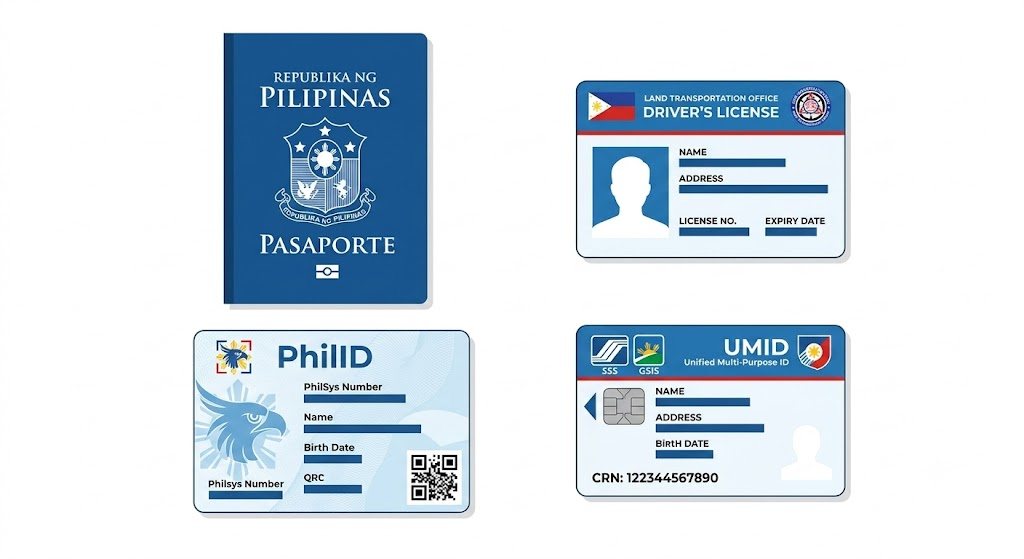
The NPCS accepts a defined set of government-issued IDs. You must bring the original physical copy.
✔ Accepted Valid IDs for Police Clearance:
- Philippine National ID (PhilSys)
- Passport (must be valid and not expired)
- Driver’s License
- UMID (SSS/GSIS Unified ID)
- SSS ID
- GSIS e-Card
- PRC License
- Postal ID
- Voter’s ID / Voter’s Certification (if accepted by station)
- PWD ID
- Senior Citizen ID
- OFW ID
- Seaman’s Book
- AFP ID
- PNP ID
- IBP ID (lawyers)
- Alien Certificate of Registration (ACR) for foreign nationals
- School ID (only in limited cases with supporting documents, depending on station policy)
Mandatory Conditions (Non-Negotiable):
- Must be ORIGINAL (photocopies are not accepted as primary ID)
- Must NOT be expired
- Must be readable (no damage, peeling laminate, or faded text)
- Must clearly show full name, photo, and signature if applicable
If any of these conditions fail, the station may refuse processing.
Does the ID Need to Match Your Registered Address?
The system does not strictly require your ID address to match your NPCS profile address.
However, your name and birth details must match exactly.
Here’s what matters most:
- Full name must match character-for-character
- Birthdate must be identical
- Spelling variations are flagged immediately
- Nicknames or shortened names cause verification issues
Address differences are usually acceptable, especially for applicants who move cities for work or study. But large inconsistencies may trigger manual verification.
The system prioritizes identity consistency over location accuracy.
Is Police Clearance a Valid ID Itself?
Many applicants ask, is police clearance a valid ID?
The answer is: No, it is not considered a primary valid ID.
A police clearance id is a background verification document, not a foundational identity card. It confirms that your record was checked through the national database, but it does not replace government-issued identification.
Here’s how it is treated:
- ✔ Accepted as supporting document in some transactions
- ✔ Used for employment background checks
- ✘ Not accepted as primary ID for NPCS application
- ✘ Not a substitute for passport, National ID, or driver’s license
A police clearance is a valid ID only in limited HR or private-sector contexts, but not for official identity verification inside government processing systems.
Final Rule
Bring a valid, original, and matching government ID. If your identity cannot be verified on the spot, your application will stop until you correct it. That is how NPCS maintains strict identity accuracy in the system.
Do I Need Barangay Clearance for Police Clearance?
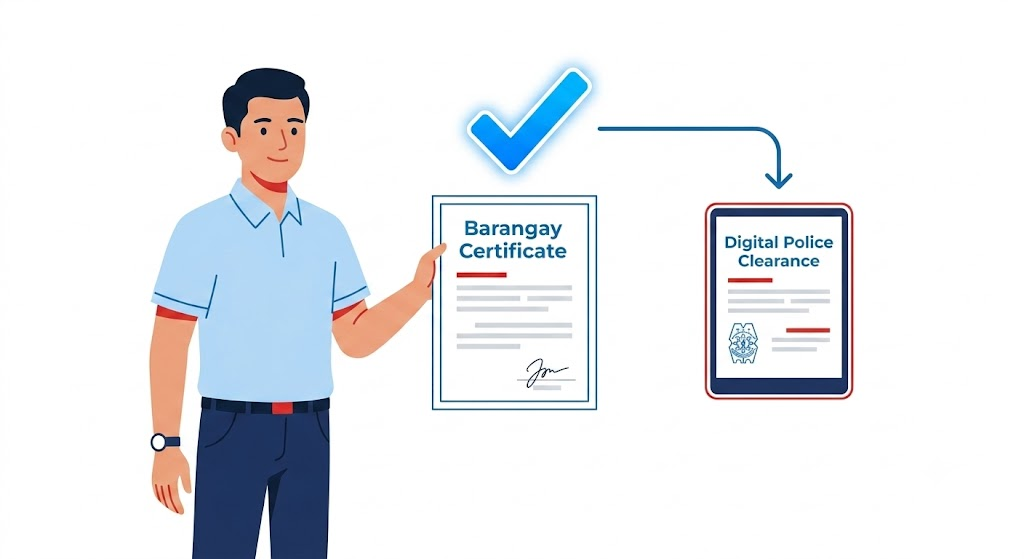
Short answer: not always.
A lot of applicants still believe that a Barangay Clearance is automatically required before getting a National Police Clearance. That’s outdated advice.
For regular applicants, the NPCS system does not require a Barangay Clearance. The process mainly depends on your valid ID, online registration, appointment, payment, and biometric verification at the station.
This is where most confusion comes from when people ask do i need barangay clearance for police clearance. The rules depend on the purpose of your application.
Myth vs. Fact
Myth: Everyone must secure a Barangay Clearance before applying for police clearance.
Fact: Regular applicants do NOT need a Barangay Clearance for police clearance. Only first-time job seekers claiming exemption may need a barangay-issued certification.
Myth: Barangay clearance is part of the standard requirements sa pagkuha ng police clearance.
Fact: It is NOT part of the standard requirement to get police clearance unless you are using a specific legal exemption.
So when you ask ano ang kailangan pag kukuha ng police clearance, the basic list usually includes a valid ID, online registration, appointment schedule, and payment—not barangay clearance.
RA 11261: First-Time Job Seeker Exemption Rules
Under Republic Act No. 11261 (First-Time Jobseekers Assistance Act), qualified individuals can get government documents like police clearance for free.
But there is a condition.
To access this benefit, you must prove that you are a first-time job seeker. This is where the Barangay Clearance or Barangay Certification becomes important.
For first-time job seekers:
- The barangay issues a certification confirming you are a first-time job seeker
- It must state that you are a resident of the barangay
- It must confirm that you have not been previously employed
- It is presented during NPCS registration or appointment validation
Without this document, the system treats your application as a regular paid transaction.
For regular applicants:
- No barangay clearance required
- No exemption processing
- Standard NPCS procedure applies
The requirement to get police clearance stays simple unless you are claiming RA 11261 benefits.
Final Clarification
Barangay clearance is not a universal requirement. It only applies when you activate the first-time job seeker exemption. Otherwise, it is unnecessary and often just delays your process if you prepare it without need.
Can I Get Police Clearance Anywhere?
Yes—but only within the rules of the NPCS system.
When applicants search police clearance walk in, the biggest misunderstanding is thinking location is the main limitation. In reality, the system is appointment-driven, not residence-driven.
You can apply at most stations nationwide as long as:
- The station is part of NPCS
- There is an available appointment slot
- Your biometrics can be processed there
Your home address does not restrict your application. What restricts you is station capacity and booking policy.
The Truth About Police Clearance Walk-Ins
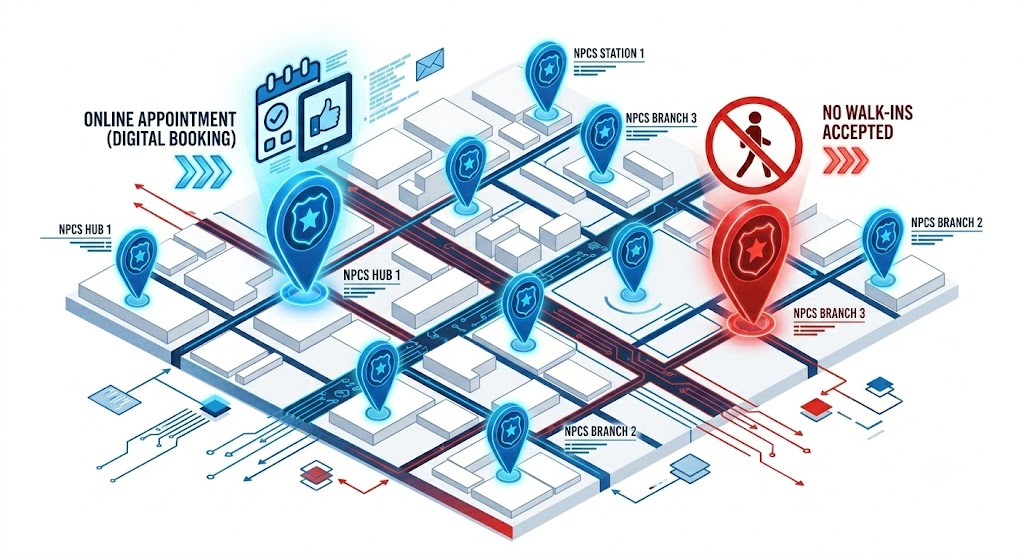
The reality is simple: NPCS is built for scheduled appointments, not walk-ins.
Most stations reject walk-ins because:
- Their daily capacity is already allocated online
- Biometrics queues are time-slotted
- System logs require pre-registered appointments
However, enforcement is not identical everywhere. Some stations strictly refuse walk-ins, while others allow limited accommodation depending on workload and officer discretion.
2-Column Reality Check
| Strict Online Appointment Stations | Stations Tolerating Walk-ins (with limitations) |
| Require confirmed NPCS booking | May accept walk-ins if slots remain |
| No entry without reference number | May allow early morning “queue list” entries |
| Fully scheduled biometric flow | Manual queueing before system encoding |
| Common in NCR business hubs | More flexible in provincial stations |
| High volume daily applicants | Lower or variable traffic days |
Even in “flexible” stations, walk-ins are not guaranteed. Priority still goes to online appointments.
Case Studies: Bahay Toro and Pardo Police Stations
High-traffic stations like Bahay Toro Police Station in Quezon City operate under strict appointment control. In most cases, officers only process applicants with confirmed NPCS schedules. Walk-ins are typically redirected or asked to book online first due to full daily slots.
In contrast, Pardo Police Station in Cebu has shown occasional flexibility depending on daily applicant volume. On lighter days, walk-ins may be placed in a standby queue, but processing still depends on system availability and officer approval.
Both stations follow the same NPCS system, but local workload changes how strictly walk-ins are handled.
Final Operational Rule
If you are planning for local police clearance requirements walk-in, do not rely on it.
Follow this rule:
- Book online first
- Treat walk-in as a backup option only
- Expect rejection in high-demand stations
The system is designed around scheduled flow, not spontaneous entry. That is the only consistent rule across all stations.
SOSIA Meaning Police Clearance: What Security Personnel Need
In the context of sosia meaning police clearance, SOSIA refers to the Supervisory Office for Security and Investigation Agencies under the Philippine National Police. It regulates security agencies, guards, and investigation firms. It also sets compliance standards for licensing, renewal, and personnel clearance.
Security guards do not just need a standard police clearance for employment. They often need a clearance that aligns with security agency accreditation requirements, which are monitored under SOSIA rules.
This is because security work involves access to restricted areas, cash handling environments, and sensitive client locations. The clearance helps confirm that the applicant has no disqualifying criminal record in the national database.
Important note:
SOSIA requires applicants to select the correct transaction purpose during application. Using the wrong purpose may cause rejection or request for reprocessing.
Why Security Personnel Need a Specific Clearance
Security guards are evaluated under stricter compliance rules because their role is classified as sensitive. Employers and agencies use police clearance to verify:
- No active criminal cases
- No derogatory record in NPCS database
- Identity consistency across national records
- Eligibility for security licensing or agency deployment
In many cases, the clearance becomes part of agency accreditation or renewal submissions.
Police Clearance Renewal Requirements
When dealing with expired documents, the police clearance renewal requirements are almost the same as a new application, but the system may already store your previous biometric profile.
Here are the exact steps for renewal:
1. Log in to NPCS Portal
Access your existing NPCS account using your registered email and password.
2. Check Existing Profile
Verify that your personal details match your current valid ID.
3. Select “Renew” or “New Application”
Depending on system availability, choose renewal or reapplication option.
4. Choose Purpose Correctly
Select the correct purpose (employment, SOSIA compliance, or agency requirement).
5. Book Appointment Slot
Pick an available police station and schedule.
6. Pay Required Fees
Settle payment via GCash, LandBank, or ECPay outlets.
7. Proceed to Biometrics (if required)
Some renewals require updated photo or fingerprint confirmation.
Requirements for Police Clearance Certificate Renewal
- Valid government-issued ID (original)
- Old clearance copy (if available, optional but helpful)
- Appointment confirmation slip
- Payment reference number
- Updated personal details (if changed)
Key Reminder
The national police clearance requirements for renewal remain strict on identity accuracy. Any mismatch in name, ID, or purpose selection may delay processing.
Security personnel should always ensure the application purpose aligns with SOSIA standards to avoid clearance rejection or reprocessing delays.
Police Clearance Requirements 2026 Updates
The police clearance requirements 2026 under the updated NPCS workflow remain fully digital-first, with stricter identity validation and tighter appointment enforcement at police stations across the Philippines.
The system now prioritizes:
- Accurate online encoding before appointment confirmation
- Stronger ID verification at biometric capture
- Mandatory QR-based validation for all issued records
- Tighter matching rules between ID details and application profile
The online application form for police clearance certificate now flags even minor mismatches in name spelling, birth details, and ID data before you can proceed to scheduling.
Your Final Day-of-Appointment Checklist
Before you go to your scheduled station, make sure everything is complete. Missing even one item can delay your release.
Bring This With You
- Valid government-issued ID (original, not expired)
- Printed or digital appointment confirmation from NPCS
- Payment reference number (GCash, LandBank, or ECPay receipt)
- Reference slip or transaction ID
- Clean, appropriate clothing for photo capture
- Optional: backup ID in case of verification issues
At the station, expect:
- Identity validation at entry
- Photo capture for system record
- Fingerprint scanning
- Electronic signature confirmation
- Clearance printing or digital release
How to Apply for Your Certificate Today
If you want to apply for police clearance certificate, follow the official NPCS process step-by-step:
- Visit the official NPCS portal
- Click REGISTER and create your account
- Complete your personal profile carefully
- Log in and select APPLY FOR CLEARANCE
- Choose your preferred police station
- Pick an available appointment schedule
- Confirm details and generate payment reference
- Pay using GCash, LandBank, or ECPay outlets
- Save your transaction number and receipt
- Wait for system confirmation before your appointment date
The req for police clearance is simple, but accuracy is critical. One wrong detail can trigger delays or system verification flags.
Final Instruction
Do not wait for urgent deadlines before applying. Slot availability changes quickly, especially in high-demand stations.
Go to the official NPCS portal now, complete your registration, and secure your schedule under the updated police clearance requirements philippines system before appointments fill up.